
Wholesale values

A wholesale value tool built on Canadian market data

Appraise gives four wholesale grades for any used car (Extra clean, Clean, Average and Rough), built from Canadian dealer listings near you and recently sold cars, adjusted for km and trim. Each value shows how many comparables it used and a confidence label, and your own max buy is calculated separately from your recon, fees and target gross.

Key facts

  • Four gradesExtra clean, Clean, Average and Rough, the same for every dealer, like a book.
  • Local firstSame trim, similar km, within your search range (300 km by default), then your province.
  • Sold beats askingWith 3 or more recently sold listings, sold prices lead the retail estimate.
  • High confidence means5 or more same-trim listings, a spread under 12% and a measured km rate.
  • Mileage lineCompares the car’s km with a typical 20,000 km a year for its age.
  • Estimates, shownTap any number to see its math. A starting point for your judgement.
The method

How are the wholesale grades calculated?

Like a book value, the grades are market numbers, the same for every dealer. Your own costs come in later, in your max buy.

Each grade works back from what the car would sell for at retail in that condition, then takes off what it costs a typical dealer to get it there and sell it:

Grade sale price (expected retail, adjusted for the grade) − Recon allowance for that grade − Typical auction fee − Typical transport − Holding cost while it sells − Typical dealer margin = Wholesale value for the grade

Rougher grades have a lower sale price and a bigger recon allowance, which is why the gap between Clean and Rough can be several thousand dollars on the same model. The app suggests a grade from your scan, photos and recon (“2 codes, $1,900 recon → Average”), and you can pick another; the max buy follows instantly.

When a grade’s costs are more than the car sells for, it says so instead of inventing a number. More on how these values relate: wholesale vs retail vs trade-in value.

Market data

Where does the market data come from?

Canadian dealer listings and recently sold cars, close to your rooftop. No US prices, no national averages.

  • Same year, make, model and trim, with similar km, within your search range (300 km by default) first and then your province
  • Listings without km, branded titles and prices far from the rest are left out, and the math sheet says so
  • Recently sold listings carry more weight than asking prices when there are at least three
  • A mileage line and a region line show how km and your province move the price

Listing data refreshes daily. Values are estimates, not a guaranteed price.
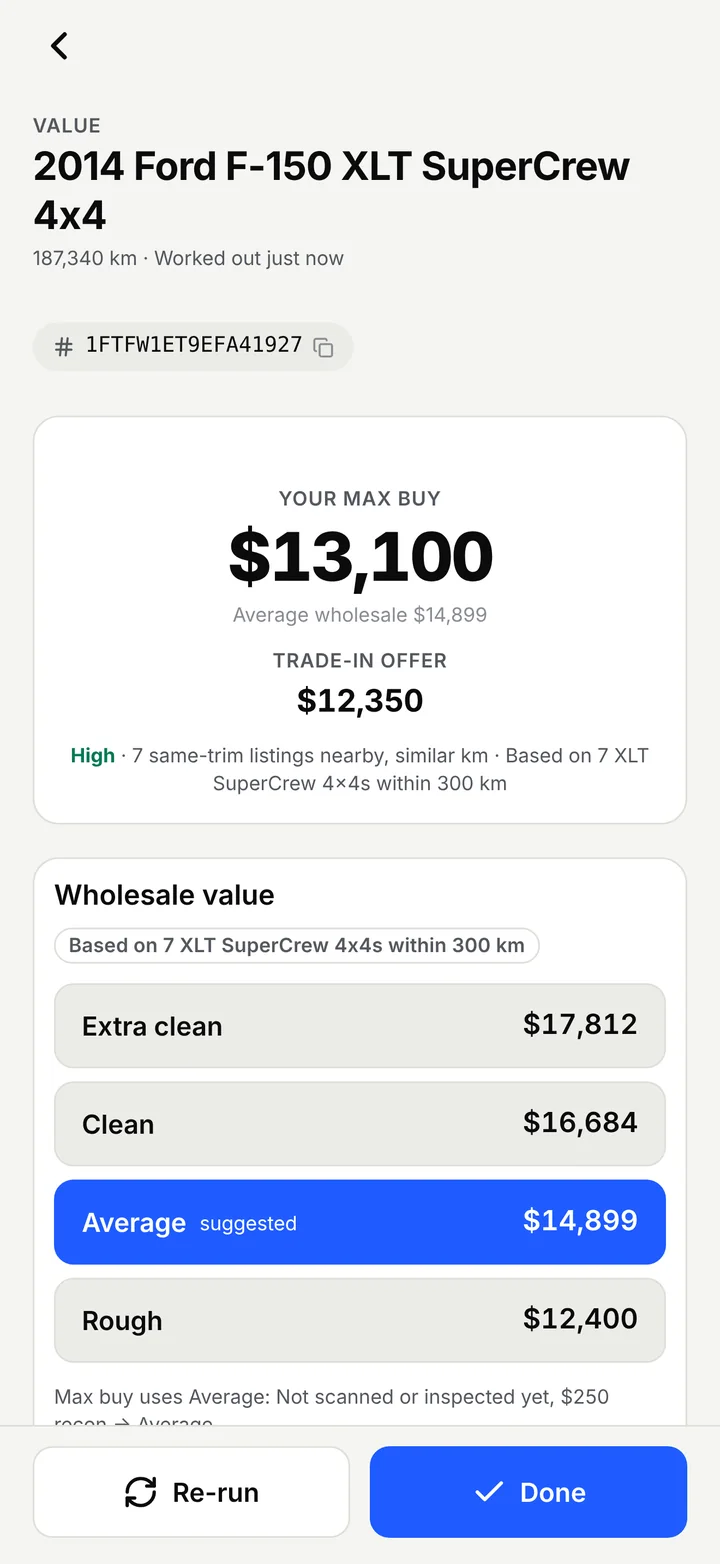
Appraise Value screen for a 2014 Ford F-150: max buy $13,100, trade-in offer $12,350 and four wholesale grades
Thin markets

What happens when there aren’t enough comparables?

Every car gets a value. When local listings are thin, Appraise steps down a ladder, tells you which step it used, and lowers the confidence.

  1. Your areaSame trim and similar km within your search range (300 km of your rooftop by default).
  2. Your provinceThe same search across your province.
  3. Canada, adjustedNational listings, adjusted to your province.
  4. Other trimsNearby trims of the same model, with a trim adjustment.
  5. Neighbouring yearsThe same model a year either side, adjusted.
  6. Market history and MSRPPast market data, then an estimate from the original MSRP. Only if there is truly nothing does it say “Not enough market data”.
Your number

How is your max buy different from wholesale?

Wholesale is what the market would pay. Your max buy is what you can pay and still make your gross, using your own costs.

  • Starts from the sale price of the grade you choose
  • Subtracts your recon, auction fee, transport, pack, holding and target gross
  • Rounded down to $50, with the trade-in offer below it
  • Never floored: if the numbers don’t work, it says no buy

Guide: how to calculate your max buy.

Confidence

How much should you trust a value?

Every value tells you how much evidence is behind it, so you know when to lean on it and when to dig deeper.

  • High confidence needs at least five same-trim listings, a price spread under 12% and a km adjustment measured from the listings themselves.
  • Medium or low confidence means fewer comparables, a wider spread, or a step down the ladder, and the label says why.
  • Counts are shown (“Based on 7 F-150 XLTs within 300 km”) so you can judge for yourself.
  • Every number opens its math, from the listings used to each adjustment and cost.
FAQ

Frequently asked questions

Something else? Email hello@appraisefordealers.ca or book a demo.

Is this the same as a book value?

It plays the same role, a market wholesale number by grade, but it is built fresh from Canadian listings near you and recent sales rather than published averages.

Are the grades the same for every dealer?

Yes. The four grades are market values. Your max buy is personal, because it uses your recon, fees, holding cost and target gross.

How current is the data?

Listing data refreshes daily, and recently sold listings cover roughly the last 90 days.

Does it work for rare or unusual vehicles?

Yes. When local comparables are thin it widens the search step by step, says which step it used and lowers the confidence, rather than leaving you without a number.

Ready to see all four grades for your next VIN?

Try it free for 14 days, no card needed. Or book a demo and we will run a real VIN with you.